








Software Architecture
| Management | |
|---|---|
| Document Owner | Harry Roache-Wilson |
| Document Responsibility | Harry Roache-Wilson |
| Document Status | Draft |
| Part of Release | N/A |
Introduction
Purpose and scope
Definitions, acronyms and abbreviations
How to use this document
Definitions, acronyms and abbreviations not defined here can be found in the Glossary.
System Context
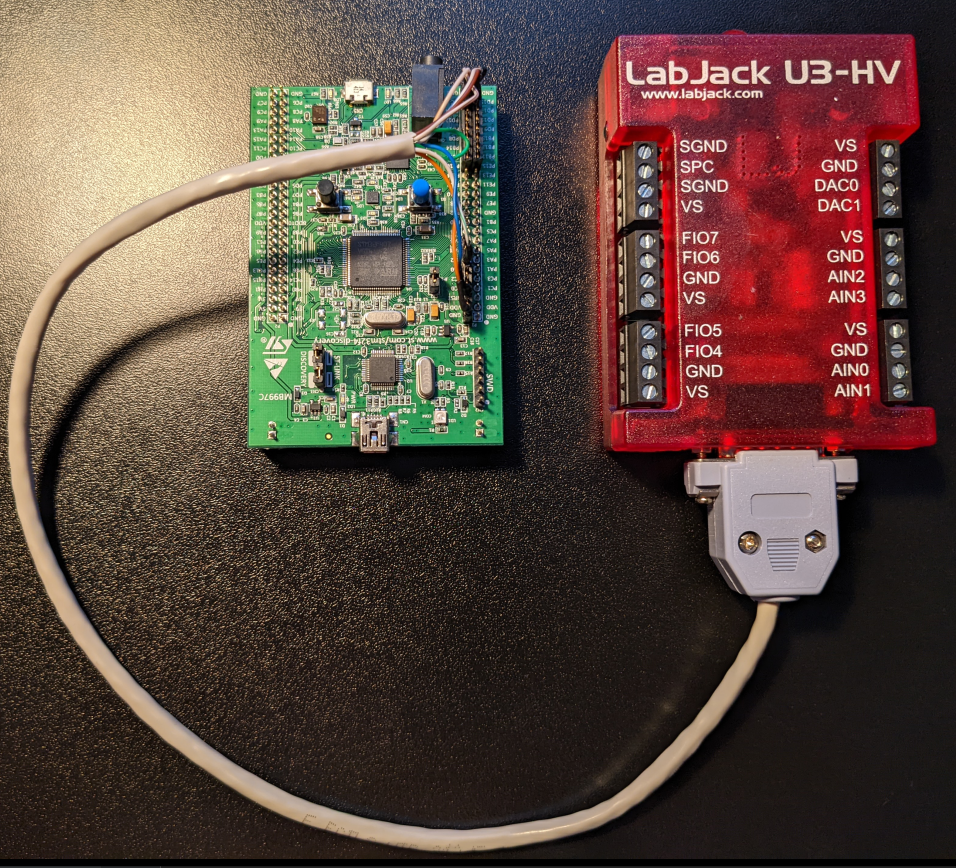
The system developed here is to demonstrate a workflow that I think is interesting. As such, it is pretty simple. Target hardware is an STM32F4 discovery board, which has a few buttons, some LEDs, and exposes a range of IO pins, including the reset pin.
Software Quality
Software quality is maintained and standardised using a range of static and dynamic analytics. Pre-commit hooks ensure atomicity and correctness of each commit. Tools are used to ensure quality of the application software, written in C++, and the test harness software, written in Python3.
- C++ tooling:
- clang-tidy
- clang-format
- cppcheck
- cpplint
- cpputest
- gcovr
- GCC sanitisers (asan only)
- Python tooling:
- black
- isort
- flake8
- mypy
Architectural Design
Software Units
The software architecture satisfies Requirements and establishes a coherent set of software units that
1) are as small as possible without being trivial;
2) are arranged into a hierarchy of abstractions; and
3) abstractions have minimal horizontal dependencies.
Often a layer diagram is a nice way to depict the relationship between software units but in this case the system is so simple that units are described standalone.
| Software Unit | Description |
|---|---|
| core | Main loop. Instantiates and executes application logic. |
| gpio | GPIO driver for leds and buttons. Provides clean interface to get/set pin state. |
| leds | Application logic for LED animations. |
| button | Button state getter including debouncing. |
Without requirements and design, programming is the art of adding bugs to an empty text file.
― Louis Srygley